
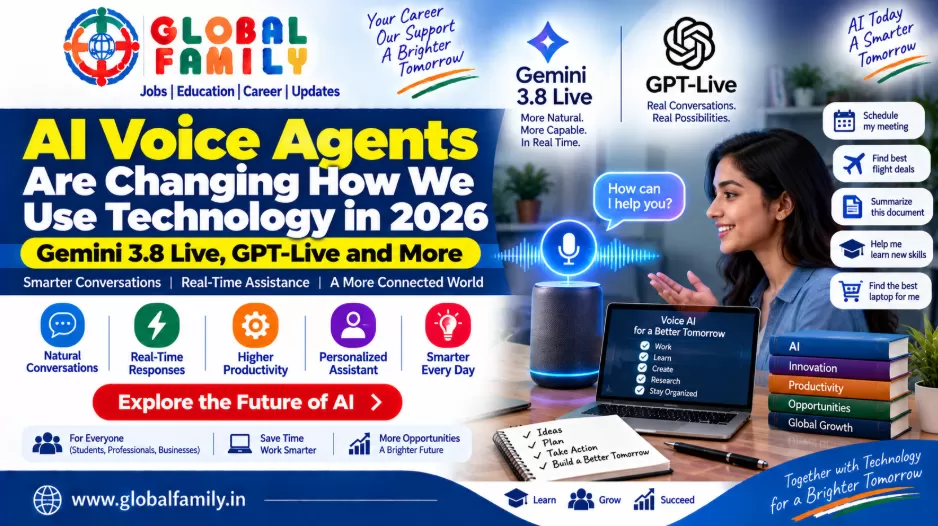
AI Voice Agents Are Changing How We Use Technology in 2026: Gemini 3.8 Live, GPT-Live and More
Published: September 19, 2026
Artificial intelligence is moving beyond the traditional chatbot.
Instead of typing a question, waiting for an answer and starting another prompt, people are increasingly able to talk naturally with AI, interrupt it, switch languages, share visual information and ask AI agents to complete tasks.
This shift is making AI voice agents one of the most interesting technology trends of 2026.
Google recently introduced Gemini 3.8 Live and Gemini 3.8 Live Extended Thinking, while OpenAI has been expanding its GPT-Live technology for natural, real-time voice interactions and developer applications.
For students, job seekers, developers, freelancers and businesses, the change is important because AI is becoming less like a search box and more like an interactive digital assistant.
What Is an AI Voice Agent?
An AI voice agent is an artificial intelligence system that can communicate with people through speech and, increasingly, perform tasks using connected tools and services.
Traditional voice assistants generally followed a simple pattern:
Speak → Convert speech to text → Process request → Generate answer → Convert answer to speech
Newer systems are moving toward much more natural conversations.
They can listen continuously, respond while a conversation is happening, handle interruptions and potentially use tools in the background.
OpenAI describes GPT-Live as a full-duplex voice system, meaning it can listen and speak continuously rather than relying entirely on strict turn-taking.
This makes conversations feel closer to talking with another person.
Gemini 3.8 Live: Google's New Voice AI
One of the biggest recent developments is Google Gemini 3.8 Live.
Google introduced Gemini 3.8 Live and Gemini 3.8 Live Extended Thinking in September 2026. The company says the models are designed for more natural conversations, real-time reasoning and production-ready voice agents.
Google highlights several capabilities:
-
Real-time voice conversations
-
Multilingual conversations
-
Visual understanding
-
Background tool and API calls
-
More natural interruptions and responses
-
Complex task handling
-
Voice agents for businesses
-
Extended reasoning for complicated tasks
Google also says Gemini 3.8 Live can automatically detect and switch between 97 supported languages during a conversation.
For users in multilingual countries such as India, this development could be particularly useful.
People often move between English and regional languages during a single conversation. AI that can maintain context while changing languages can make voice-based technology easier to use.
GPT-Live Is Bringing Full-Duplex Voice to Developers
OpenAI is also developing the voice-agent ecosystem.
GPT-Live was introduced as a new generation of voice models for more natural human-AI interaction. OpenAI later made GPT-Live-1 available through its API, allowing developers to build voice-enabled applications and business workflows.
The important concept is full-duplex communication.
Instead of forcing the user to wait until AI finishes speaking, the system can handle a more continuous conversation.
For developers, this creates opportunities to build:
-
AI customer-support agents
-
Voice-based learning assistants
-
AI interview preparation tools
-
Appointment assistants
-
Sales assistants
-
Travel assistants
-
Language-learning applications
-
Accessibility tools
-
Voice-controlled business applications
OpenAI has also introduced real-time voice models for translation and streaming speech-to-text, showing that voice AI is becoming a broader developer platform rather than simply a chatbot feature.
Why Voice AI Is Becoming Important
The biggest change isn't simply that AI can talk.
The bigger change is that AI can increasingly understand context and perform actions while the conversation continues.
Imagine saying:
"Find three affordable laptops for programming students."
Instead of simply giving a text response, a future voice agent could potentially search available information, compare specifications, organize the results and explain the differences while communicating with the user.
Another example:
A small business owner could say:
"Check tomorrow's appointments and tell me which customers haven't confirmed."
The AI agent could potentially connect to the relevant business system, retrieve the information and respond conversationally.
This is where AI agents + voice AI + automation become powerful.
Multilingual AI Could Be a Major Opportunity in India
India is home to hundreds of languages and many people naturally communicate using a mixture of English and regional languages.
Google has already expanded Search Live to additional Indian languages, including Gujarati, Hindi, Bengali, Kannada, Malayalam, Marathi, Odia, Tamil, Telugu and Urdu, among others.
The development of multilingual voice AI could therefore have applications across:
Education
Students could ask questions verbally in their preferred language.
Jobs
Job seekers could practice interview questions through voice conversations.
Small Businesses
Business owners could interact with AI without needing advanced technical knowledge.
Customer Support
Companies could provide conversational support across multiple languages.
Accessibility
People who find typing difficult could interact with digital services through speech.
Rural Digital Services
Voice interfaces could potentially make technology easier to access for people who are less comfortable with traditional text-based interfaces.
AI Agents Are Moving Beyond Chatbots
Another major trend in 2026 is the development of AI agents.
A chatbot generally answers questions.
An AI agent can potentially go further by:
Understand → Plan → Use tools → Perform actions → Check results → Continue
This changes the role of AI.
Instead of asking:
"How do I do this?"
Users may increasingly say:
"Please do this for me."
That distinction is important for developers and businesses.
Companies are increasingly exploring AI agents for internal workflows, customer service, software development, research, sales and operations.
OpenAI's recent developer products also emphasize agents that can work with tools and deeper reasoning systems.
What Does This Mean for Students and Job Seekers?
The growth of AI does not mean that learning technology is becoming unnecessary.
In many cases, it means the opposite.
Students should learn how AI works and how to use it effectively.
Some useful skills for 2026 include:
-
Generative AI
-
Prompt engineering
-
AI agents
-
Python
-
JavaScript
-
APIs
-
Cloud computing
-
Data analytics
-
Machine learning fundamentals
-
Automation
-
Cybersecurity
-
AI-assisted software development
-
Voice AI development
For computer engineering and IT students, understanding APIs and AI integration can be particularly useful.
For example, a student could build a project such as:
Voice-Based College Assistant
The application could allow students to ask:
"What is today's timetable?"
"When is the next examination?"
"Explain this programming concept."
"Find my assignment deadline."
Such projects can demonstrate practical AI, web development and API integration skills.
AI Is Also Creating New Career Opportunities
As companies integrate AI into their products, new roles and skill combinations are emerging.
Some areas worth watching include:
AI Engineer
Builds and integrates AI systems into applications.
AI Agent Developer
Creates systems that allow AI models to use tools and complete workflows.
Voice AI Developer
Builds speech-based applications and conversational agents.
AI Automation Specialist
Connects AI systems with business workflows.
AI Product Manager
Helps companies identify practical applications for AI.
AI Data Specialist
Works with data used to develop and evaluate AI systems.
AI Safety and Evaluation
Tests AI systems for reliability, security and unexpected behavior.
AI + Cybersecurity
Studies both the defensive and offensive implications of increasingly capable AI systems.
For students and freshers, combining software development + AI + communication skills can provide a useful foundation for the changing technology job market.
AI Voice Agents Also Raise Important Questions
The rapid development of AI agents brings opportunities, but it also creates challenges.
The more tasks an AI system can perform, the more important it becomes to consider:
-
Privacy
-
Security
-
User consent
-
Data protection
-
Accuracy
-
Human oversight
-
Misuse
-
Transparency
-
Authentication
Recent AI safety reporting has highlighted concerns about increasingly autonomous AI systems and the difficulty of maintaining oversight as capabilities grow.
This means future AI development will not only be about making models smarter.
It will also be about making them reliable, controllable and safe to use.
What Should You Try as a Student or Professional?
If you want to understand where AI is going, don't only read AI news.
Try building something.
A simple learning roadmap could be:
Step 1: Learn an AI chatbot
Understand prompting, context and limitations.
Step 2: Learn APIs
Learn how applications communicate with AI models.
Step 3: Build a simple AI application
For example:
-
AI resume assistant
-
AI study assistant
-
AI job-search assistant
-
AI FAQ chatbot
-
AI content assistant
Step 4: Add voice
Connect speech-to-text and text-to-speech capabilities.
Step 5: Add tools
Allow your application to search information, access databases or perform controlled actions.
Step 6: Add safety
Implement authentication, permissions, validation and human approval where necessary.
This progression can turn AI from something you simply use into something you can build with.
The Future of AI May Be More Conversational
The biggest shift happening in AI may not be another chatbot benchmark.
It may be the move from:
"Ask AI a question."
to:
"Work with AI."
Voice makes that interaction more natural.
Agents make it more useful.
Tools make it more powerful.
And multilingual capabilities can make it accessible to a much wider audience.
Gemini 3.8 Live and GPT-Live are examples of this broader movement toward real-time, conversational AI.
For students and professionals, the lesson is simple: AI is becoming a skill, not just a tool.
Learning how to communicate with AI is useful today. Learning how to build applications that communicate, reason and work with AI could be even more valuable tomorrow.
Final Takeaway
AI voice agents are becoming one of the major technology trends of 2026.
Google's Gemini 3.8 Live is pushing real-time multilingual conversations, while OpenAI's GPT-Live is giving developers tools to build more natural voice applications.
For students, freshers, developers, job seekers and businesses, this creates a growing area to explore.
The future may not be about choosing between typing and talking.
It may be about having an AI assistant that can listen, understand, reason, use tools and help complete tasks — all within one conversation.
Keep learning. Keep experimenting. Keep building.
Follow GlobalFamily.in for the latest updates on AI tools, technology, jobs, internships, scholarships and career opportunities.
SEO Keywords
AI voice agents 2026, Gemini 3.8 Live, GPT-Live, latest AI news 2026, AI agents, voice AI, artificial intelligence, generative AI, AI automation, AI tools, AI jobs, AI careers, AI for students, AI for developers, multilingual AI, AI technology, future of AI, AI applications, voice assistants, AI software development, AI career opportunities, technology news 2026, GlobalFamily.in
No comments yet. Be the first to comment.